Showing posts with label literary. Show all posts

Tuesday, June 28, 2016

Reasons Why I Love Marvel Films

(an open letter of appreciation to everyone involved with the MCU that will never get read but that I want to write anyway)

I've been on a major Marvel movie kick lately, and I've been thinking about why they are so enjoyable.  Here's what I've come up with so far.

1)  A legitimate effort at fun has been made - Every day, it seems like the news is full of new horrors. People are killing each other for no legitimate reason.  Things are disappearing or being used up. Both America and the world seem to be increasingly divided.  People are just plain hateful to each other based on differences which make no difference.  Our political landscape is filled with a wide array of non-choices we'll have to pick from in a few month.

One of the greatest uses of entertainment is being able to escape all that, even for 120 minutes, and Marvel films do that so well.  The interplay between the characters is always a delight.  The snark between Hawkeye and Quicksilver in Age of Ultron. Tony Stark bating...pick a character.  Anyone.  Everyone, really.  Ant Man in Iron Man's wiring or in Sam's Falcon suit. Ant Man getting punched in the face by Hope.  Happy getting taken down by the Widow.  Spiderman and Bucky.  (Spiderman and everybody.) The entire Bucky/Sam dynamic.  One of my favorite scenes of all time was in Civil War when all those huge, ridiculously powerful guys are crammed into that old Volkswagen and Bucky asks Falcon to move his seat but Sam refuses.  It was short, little compared to the huge drama going on, but it was perfect.  My immediate thought was, "Actual Crap Guys Do."  I still snicker thinking about it.

And don't even get me started on Deadpool.  That entire film is just a gift.

2)  A legitimate effort at more than just escapism has also been made - Because they're not just fluff.  Even when we laugh at the one-liners, we can come away from the films thinking seriously about important concepts.  Loyalty (and who deserves it), purpose, self-definition, coping with situations that we can't control, the need for second chances, who gets to write history and tell stories, the effects of conflict and violence on the macro and micro level, it's all in there.  If you don't believe me, go to Tumblr for about five minutes and look at the way that talking about Marvel films is allowing people to talk about the very same real-world issues they help people escape for a minute, too.

It's a little like Shakespeare to me.  (I'm going somewhere with this.  I promise.  Don't throw things or pass out.)  He used these fabulous characters and riveting stories to present important ideas.  Mercutio is fabulous, so sparkly he almost steals the entire play from that other moody teen, but what we need to learn from him is that his excess destroys him and that friends can get caught up in our drama whether we intend them to or not.  Hamlet, with all his intelligence and sublime skill with language, teaches us it is possible to wait too long and that everybody suffers from it.  Macbeth shows us what happens when ambition subsumes loyalty and character.  And on and on.  This is a whole separate blog post from me, so I'll stop here.  What I'm saying is that the MCU films do a lot of this same kind of thing.  There's something deeper at the core of them that makes them more than blockbuster entertainment.

3) Even though it can't be easy to be an actor for these films, they always look like they like each other and like what they do - I know that being a part of something like the MCU has got to be a big choice for an actor for a lot of reasons.  I assume they are physically rigorous films, especially since many of the actors seem to be doing as many of their own stunts as they can.  They also seem to require long commitments to the franchise.  I don't know if that's a bad thing or not, but I'm assuming it limits what actors are allowed to do otherwise even though most of the MCU films do well at the box office.

I also figure that being a part of something like MCU denies those actors a great deal of the pleasure of being an anonymous person.  I'm just a lowly school teacher, nothing so public and glorified as a film actor, but I actually love to go hang out with my friends who live in other cities just for the sheer pleasure of not having to worry about who I'm going to see that might know me. I'll never forget the time I got one of my ear piercings redone and came to school the next day to be told, "We saw you getting your ears done."  I hadn't seen them, and the entire thing was paranoia-inducing.  Where were they?  Why did they care?  Was I floating around out there in a Snapchat getting my ears repierced?  Jesus....  If it's like that for me as a public school teacher, can you even imagine what it is like to be one of the actors in these films?  Is there anywhere they can enjoy being just them and not Cap or Nat, Bucky or Tony Stark?  I hope so.  Everybody deserves a place to be simply themselves.

The biggest thing I guess I'm talking about is the apparently endless parade of interviews and convention panels.  Because I have a board on Pinterest called Geekery that I add stuff to from Doctor Who, Star Wars, MCU films, etc., I see a bajillion interview pins (again, probably mostly assembled from things from Tumblr, that frothing bastion of fandom, God bless it).  It has to get old.  I wonder how many thousand times they get asked the same questions.  Some of the things I see they've been asked are things I wouldn't be able to respond to well, but they always seem to stay classy (reasons they're actors and I'm not, probably).

In spite of all these things that would be drawbacks to me, they also always look like they like each other and are having a lot of fun. They support each other, defend each other from the really brainless, tactless, and crass questions.  I really hope that's true.  I hope that they look forward to making these movies and mess around on set and during those ridiculous interviews and are basically just happy.  Maybe they don't all hang out at one of the hundred-and-eighty-seven-guys-named-Chris's houses on the weekend, but while they're there, it seems like they're having a blast. It increases the enjoyment of the films to me to think that it's in some way an effort of friends.

4) The female characters kick ass - The women are as interesting and strong as the men and nobody acts like that's anything other than the way it should be.  I have loved Wonder Woman since I was a little girl small enough to fit into Underoos, and I have always, always wanted to see a film in which she was not a cameo or just done wrong.  Marvel doesn't seem to have that issue. They aren't afraid of women who can hold their own. I can't wait to see Hope Pym as the Wasp.  When the Scarlet Witch blasted Vision through the floor in Civil War, I (silently) cheered.  Kick that ass, girl.  I'm still catching up on the Daredevil series, but Electra is so very well done, deadly and complicated.  And yes.  Like the rest of America, I do want an entire Black Widow movie.  She deserves it. (And throw some Red Room Bucky up in that, too.)

5) They are not afraid of brokenness - All of the MCU heroes have big, huge faultlines running right up the middle of them.  Serious things have happened to them, things they couldn't control.  They've made choices the best they could or had all their choices taken from them.  Accidents have happened.  They lost things.  They lost people they loved.  They've lost part or all of themselves.

Bucky is the poster boy for this and one of my very favorite characters in the entire MCU. Each time we see him in the films, he is picking the pieces of his life up and sorting through them. Even though he has been as destroyed as a person can be, with the help of his friends, he is trying to put those pieces back in place. Sebastian Stan does an amazing job showing this process.  Bucky can't be easy to play.

This is what real life does.  All that ugliness I mentioned at the top that surrounds us every day is doing this stuff to us, and we have to pick ourselves up and deal with whatever remains.  I think the MCU heroes do an excellent job of giving hope that it is possible to stand up and keep trying.  Sure, we're never going to be kidnapped by HYDRA, twisted by the Red Room, recreated by the mind stone, but we are going to get knocked down, hurt in hearts, minds, and bodies, and there's a lot to be said for seeing survival of the worst in fiction.  It's important to have stories that show us people can overcome.

6) The villains are complicated - As a million little Loki fangirls will attest, even Marvel's bad guys aren't simple.  Maybe it's the richness of the decades of source material and all the incarnations they've gone through as different writers shaped the characters, but instead of just big powerful evil, there's always a reason. There's always a backstory.  They aren't Iagos; they're Claudiuses. (And I promise, that's my last Shakey reference.) The Marvel villains are the flip side of the hero's brokenness.  They show us what happens when you choose NOT to get up.  When you choose to hold on the the darkness instead of finding some way to purge it or leave it behind.  They are as important in that dynamic as the heroes are.

My favorite of them is almost inevitably Wilson Fisk.  D'Onofrio always amazes me with the depth he brings to anything he plays, and his portrayal of the many, many layers behind Kingpin is one of the main reasons I like Daredevil so much.  The character is absolutely terrifying, utterly ruthless, but as the details of his becoming are revealed, it becomes possible to have compassion for him.  Then he decapitates somebody with a car door, and you are not quite sure how to feel.  That's the way a good villain is supposed to function.

7)  The characters grow and change - Captain America has undergone this beautiful and complex transformation, but all of them evolve.  The Tony Stark we saw in Civil War wasn't the same guy from Iron Man.  All the characters in Daredevil are shifting, and it's impressive to watch.  Even fairly newly-introduced characters like the Scarlet Witch and the Black Panther have changed dramatically from who they were when we first met them.  Others are poised on the edges of that kind of change, especially Bucky, and I hope we get to see it happen. Real life leaves marks.  When characters don't change due to what they encounter, they're allegories, and while allegories are interesting, I don't think we learn as much about survival from them as we do from more dynamic characters.

And I could probably go on, but I'll stop here.  It may seem kind of an odd thing for me to write about, but it's what was on my mind today.  Gotta go watch a movie.

Monday, September 14, 2015

A Good Man Is Hard to Find

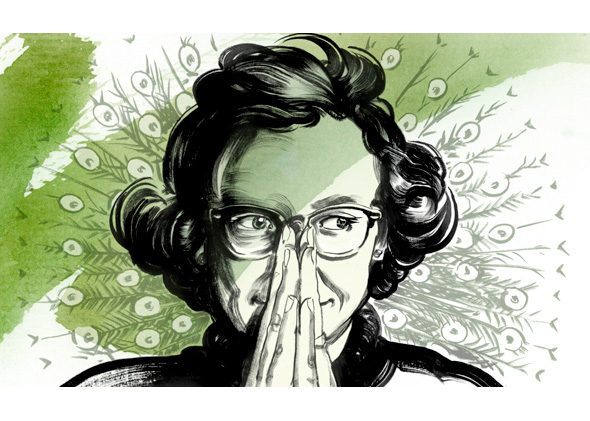
You shall know the truth, and the truth shall make you odd.  

The truth does not change according to our ability to stomach it. 
- Flannery O'Connor

Listen to Bessie while you read this.  She's never, ever a bad idea...

Tonight, I taught Flannery O'Connor's short story "A Good Man Is Hard to Find."  Although I've read it several times before, this was my first time using it in instruction, and as is always the case, I learned an incredible amount about it through the process.  Sometimes I think I get more out of teaching the stories than my classes do from being taught.

Tonight, the moment of transformation that takes place for the grandmother really struck me.  The whole way through the story, she is obsessed with things that are surface or things that are gone.  She romanticizes the Old South where every old homestead was a plantation, where every plantation had hidden silver waiting in the walls,  and where "gracious living" with dress codes and manners marks the worthy.  She believes she can tell a "good man" based on what he looks like, what his speech patterns are, who his "people" are.  She believes herself to be a good woman, a Christian person.

And then reality comes crashing in, quite literally.  

When she is staring down the barrel of the gun, for the very first time in her life, all the externals she has used to insulate herself from real application of the religion she gives lipservice to are stripped away.  There is no protection to be found in her white gloves and navy straw hat.  There is no grace given because she has manners and respect for the place she's from.  Her comfortable life which has allowed those moments before where she's been snide, snobby, or indifferent to the suffering of others is on the verge of ending.  Only in that moment does she understand the reality of the world, the reality of her faith.

She reaches out, and in her sudden and total acceptance of someone who is going to reject it, in her compassion for someone who is going to take her very life, she connects to the core of Christianity.  The same woman who callously ignored the needs of the little child on the roadside is reaching out to the Misfit, and when her hand touches him, something far more significant occurs.  She becomes the thing she's only been pretending to be.  She becomes a good person.

And it's dangerous to be genuinely good in a world that prefers superficiality.  It's costly.  At the end of the story, though, even after she's paid that price, she still smiles.  Something that the Misfits of the world cannot take away even through violence remains.

I need to read more O'Connor.  She's portraying something she calls Christian realism, and the combination of those two concepts intrigues me.  I'm going to be thinking about this one for a long time.  

Sunday, February 22, 2015

Literary Epiphanies

I went to the annual Eudora Welty teacher workshop Friday.

Getting there was nightmarish.  Ice had gridlocked the entire city of Jackson.  All roads in and all roads within were obstructed by wrecks.  The dreaded "stack" where I-20 and I-59 go their separate ways was completely closed.  Insanity reigned supreme with selfish motorists refusing to move out of the way of incoming emergency services.  I personally sat about five miles outside of Brandon for 45 minutes, engine off, waiting for some accident I never saw any trace of to be cleared.

When I finally got to Welty House, I was late.  I scurried in and took up a seat in the back.  The two stories we were to have read before arriving were already under discussion.  I quickly got my pen out and started filling pages of notes.

These moment where I get to be a student again are precious.  I love to learn, feed on it just as much as I get nourishment from any kind of food.  I don't know how people function who never take in new knowledge somehow.  I always feel like my brain is like a pool, and if no new material is added, I swear I can feel it getting stagnant and brackish.

The two stories we were contrasting were "The Wanderers" by Welty and "The Dead" by Joyce.  I've been on something of a Joyce kick lately (the Moderns in general, but Joyce particularly).  F. got me started on the Joyce, an author I had avoided for years because of all the pretentious blather he gets in my field.  I can't think of another author who has more of what I have always thought of as the "Emperor's New Clothing Syndrome" attached to his name than Joyce, by which I have heard people who quite obviously had no more idea than the man in the moon what was going on in his works loudly discussing him like they were going to get some kind of celestial brownie points for doing so.  In any case, at F's urging, I decided to see what the fuss was about.

(Side note about that:  He sort of had to prod me a lot, and I was fairly grumpy and grudging with my acceptance. You would think by now I would just accept what F. said and go on.  He is the one who got me to listen to Dylan and at least a couple of other things I had decided that I was not going to fool with because of all the loud-sounding nothing that surrounds them.  He is right about things I will like to a degree that I do not understand.  I haven't reached the point of just going along with it, though.  I am aware that it is a character flaw.  If you try to push me toward something, you can be pretty sure I'm going to move it to the bottom of my list of priorities or refuse it altogether.  I know this behaviour is hardheaded and almost certainly unwise.  Can't seem to fix it, though.)

I was surprised when I liked what I was reading.  There was none of the deliberately abstruse stuff I'd always heard of.  The stories were engaging.  I finished Dubliners quickly and moved on to Ulysses.   I got about halfway through it before the semester started jumping up and down on me with its great black jackboots, so I am still plowing my way through it in doses.  It requires more concentration than Dubliners, more than most works I've read in my time studying literature, and while I like that about it tremendously, at the end of a long day, I don't always have that to give.

In any case, when the conference rolled around this year and I saw the pairing of Welty and Joyce, I was pretty excited about it.  I had never really thought of them together, but when I saw the titles, putting them together seemed perfectly logical.  Both are acutely interested in place and how it shapes culture and the characters they present.  I expected to learn a great deal and maybe figure out how to put both stories into the course syllabus I'm always in the middle of tearing apart and putting together, a little like faithful Penelope and her permanently unfinished weaving.

What I did not expect was a sharp and personal revelation.

Both stories have at their heart a trapped wanderer who has to lose what is precious to become free.  There are two different reactions reflecting the drastically different world views of the two different authors behind them.

Both Welty and Joyce were themselves wanderers.  Welty left Jackson for a long time for school and travel, but she had that permanent and inexplicable need to return that seems to be something we take in with the waters here in Mississippi.  She came home to take care of her family when they needed her.

Joyce left Dublin, that big city that felt so small, and refused all aspects and claims of its culture and practices.  He refused even to kneel at his mother's deathbed.  He was constantly seeking something somewhere else, yet his writing stays eternally tied to Dublin, picking it apart piece by piece in his works. For him, there is a paralysis that settles over life in Ireland, something caused by politics, religion, family.  All of it was a crushing weight that froze an individual in place, and in his stories some who are trying to escape come to a realization that they are not what they thought they were, become "sadder and wiser" because of it.

Welty, too, feels the power of place over her characters.  Family ties and cultural expectations reach out and twine around her wanderers, too.  She has a gently satirical eye for all the human frailty and foolishness that is a part of every community.  Unlike Joyce, though, I think Welty can see that there is good mixed in with all that stuff, too.  Her Wanderer, Virgie, has gone out and come back.  She has given up years of her life trying to fulfill the requirements of family and cultural duty.  As the oldest daughter, it's her job to take care of her mother.  At the end, when all the ties of family and property and obligation fall away from her, unlike with Gabriel in "The Dead," a sense that she is going to be okay now comes.  She has been changed, shaped, by all her experiences and decisions, but there is hope at the end.

And that is a critical thing.  That is the thing that I kept missing in Joyce.  I enjoy his stuff, but at the end of the day, I miss that glimmer of hope.  Maybe it's a Mississippi thing.  I see the same difference when I compare Faulkner and Hemingway.  I love them both, but there is usually a comfort at the end of Faulkner that I cannot always find from Hemingway.

I have to believe that this possibility of hope and comfort *is* present if we will look for it.  I think Welty gives it to us maybe in part because she comes back to a place that is probably not exactly where she wanted to be but she lives in it and makes something of it.  Instead of it becoming a stagnation that destroys, for her, it becomes an exercise in seeking the good, finding it wherever it appears, the garden, her friends, the ridiculous, the beautiful, the everyday miraculous.

I want to be more like Welty.  I, too, feel completely trapped here.  I am a wanderer who came home, and I can feel the weight of obligations and cultural issues sitting on me like bricks on bird wings.  Sometimes, it almost feels like there's not enough air to breathe.  I don't want to be like Joyce, though, and just lump the baby and bathwater together as I toss it all out the window.  There *is* the possibility of hope and comfort.  There are lessons to be learned if I persist.

Hamlet (you knew he was showing up sooner or later, right?) says that "There is nothing either good or bad but thinking makes it so."  I have been so focused on all the things I do not like about being home that I am forgetting there are a great many good things here, too.  I think it's time to adjust my focus.  Lincoln famously said, "Most people are about as happy as they make up their minds to be."  Time to pick Welty's Wanderer instead.

Thursday, March 20, 2014

Prufrockianism and Other Poetic Clap-Trap

I haven't written in a long time because I haven't been able to bring myself to it.  I think about this space, and I think about the need to put words down to clear out my head, but for reasons I cannot look at clearly except out of the corners of my eyes, I always find other things to occupy my time.

And mostly, I've been happy.  There have been moments, but mostly, I've been trying to be happy and healthy and content.

It doesn't always work that way, though.

The nightmares are back lately.  Maybe it's the change of seasons or the phase of the moon.  I don't know.  I just wake up feeling old and tired, sick and sad.  It doesn't matter if I've slept for eight hours or three.

Tonight, I acutely feel my losses, all of them.  I feel the absence of people I lost or who threw me away.  I feel all the bumps and stones under my feet on this road less traveled, and I can't help but wonder what it would have been like to have taken the other damn one.  I feel the impact of every sling and arrow.

I create horrible, maudlin pastiches of literature, too, apparently....

Leaving all the greats alone, then, I find myself slipping a finger across the glossy screen of my cellphone, and images of Istanbul and Brazil flicker past.  I stop on a view of the Ayasofia at sunset, and I keep feeling like if I could just get there, just hear the call to prayer floating again, I could be okay somehow.  That distance and that certain slant of light could somehow combine into something strong enough to hold all the pieces together.

Would that really soothe this saudade, this painful/beautiful longing in my heart?  I don't know. Maybe it's just an illusion.  The wise say that travel gets us nothing but what we took there with in the first place anyway, don't they?  And maybe tomorrow will be an optimist's dream, filled with peace, progress, and plenty.  Maybe the sun really will come out.  Maybe all the mermaids really will sing.

I keep having those Prufrockian moments, though, and I have to say that I am pretty sure they won't be singing to me.

And now, having danced clumsily through Shakespeare, Brazilian Portuguese, Eliot, Frost, and popular musical theater, I think it's time to face whatever face whatever comes to see me in my dreams tonight has picked out of its prop closet.

Good night.

Saturday, January 11, 2014

A Twenties Sort of Day

In the last 24 hours, I've read two and a half books.  The first two were utterly forgettable fluff.  The third, though, has been fabulous.  It's Bill Bryson's One Summer:  America 1927.

I've read a lot of Bryson's books, and he has the ability to make any subject fascinating.  I have no idea how many hours of research it must take him, but he never fails to show all the layers and connections of his chosen subject.

He also never fails to infuse that subject with humor.  Sometimes, it's just subtle irony.  Sometimes, it's absolutely side-splitting stuff.  His A Walk in the Woods has several passages that make me laugh until I cry.

In this book, he's walking the reader through the Roaring Twenties, showing how all things and people are connected by looking at one singular summer.  While it's true that a lot happens in this brief time, he doesn't limit the scope to just those weeks.  He traces histories and causes of the things that arise, and he also in some cases goes on to show the long-lasting repercussions and legacies.  It's fascinating.

So many of the people and things he's covering have become so well-worn in even the most basic overview of the history of the 20s that I don't think we generally appreciate how much work went into them and how special they really were.  He covers baseball, Prohibition, Lindbergh, politics, finance, international relations, and I'm only about halfway through.  It's fabulous.

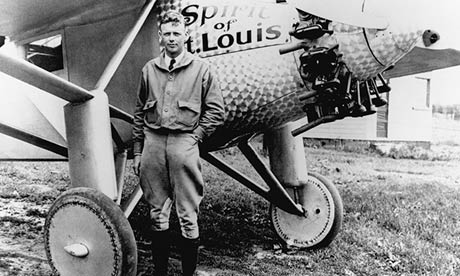
Lindbergh is one of the key figures.  Everybody knows he was the first non-stop flight over the Atlantic.  Bryson presents the reader with so many things that have gotten lost from the broader, timeline-dot sort of approach to history. I know I personally walked through the Air and Space Museum and saw The Spirit of St. Louis, sort of took a moment to notice it and moved on.  Had I read this first, I think I could have appreciated it vastly more.  To tell the truth, I spent so little time and knew so little that I didn't even notice that it was a canvas plane treated with a metallic varnish.  Bryson's account brought home how terrifying it must have been to try to cross an ocean in what was essentially "a flying tent."  I can start to give the accomplishment the recognition it deserves because now I have a feeling of these people as more than photographs and footnotes.  I appreciate that depth tremendously.

This is what history textbooks should be like.  They should be less concerned with bulleted lists and more concerned with telling the story of the amazingly interconnected web of events that shapes the world.  I know that I began to love history only when I had a professor who made those connections for me.  My History of England professor assigned us readings that were largely bone dry, but in class, he told us stories of the very real people who were involved in, creators of, or trapped by the wheel of time.

If you're interested in American history, the 1920s, aviation, baseball, literature, politics, or just basic human life, I highly recommend this book.  I think it has something for everyone.  For me to say that and not have finished yet is probably the biggest indicator of how good I think it is.


Tuesday, December 24, 2013

A Hopeful Song

"I Heard The Bells On Christmas Day" lyrics
(Henry Wadsworth Longfellow (1807-1882), 1867)

I Heard the Bells on Christmas Day
Their old familiar carols play,
And wild and sweet the words repeat
Of peace on earth, good will to men.

I thought how, as the day had come,
The belfries of all Christendom
Had rolled along the unbroken song
Of peace on earth, good will to men.

And in despair I bowed my head:
"There is no peace on earth," I said,
"For hate is strong and mocks the song
Of peace on earth, good will to men."

Then pealed the bells more loud and deep:
"God is not dead, nor doth he sleep;
The wrong shall fail, the right prevail,
With peace on earth, good will to men."

Till, ringing singing, on its way,
The world revolved from night to day,
A voice, a chime, a chant sublime,
Of peace on earth, good will to men!

----
I've heard this song and played this song a million times.  It is only this year that it finally sank in.  Isn't it funny how you can suddenly encounter something for what feels like the first time even after having it underfoot for a lifetime?

The third and fourth verses are the ones that moved me.  Despair is all around.  Darkness encroaches.  Every day our news is full of violence and hate, greed and self-interest.  The song doesn't end there, though.  Even the bells know the antidote, "God is not dead nor doth he sleep."  No matter how bad things get, there is cause for joy and hope in that. Someday, "the wrong shall fail, the right prevail" and we will have that peace and goodwill we so desperately need.

Merry Christmas to you one and all.

A Christmas Carol

“I will honour Christmas in my heart, and try to keep it all the year. I will live in the Past, the Present, and the Future. The Spirits of all Three shall strive within me. I will not shut out the lessons that they teach!”
― Ebenezer Scrooge, A Christmas Carol

I haven't felt very Christmassy this year.  Music is the best of Christmas for me, but this year, the songs make me cry.  Family gatherings are also usually a great joy.  This year, nothing but anxiety fills me.  It's okay.  I'm moving through something, and it is going to take time.

Even though there's all this stuff going on, though, some parts of Christmas shine through.  I'm watching the Patrick Stewart version of Dickens's A Christmas Carol.  I watch one version or another almost every year.  Of all the Christmas movies and feel-good stories out there, this one is the ultimate for me.  This version is one of my favorites because it is so well done.

I always feel so for Scrooge.  He is a person who built walls between himself and others because...because it seemed right at the time.  Because it seemed the way to get what he thought was the most important thing in life.  Because he was hurt and knew no other way to deal with the pain.  Somewhere along the way, those walls started to grow on their own, and by the time we meet Scrooge, he's blocked off from every human feeling.  A gentle nudge won't do.  Walls only come down with the brute force of a sledgehammer.  And when those walls do start to come down, he begins to understand what is and is not worth the price of life.  What does and does not enrich and redeem the time that is given.

The Ghost of Christmas Present is an example of this.  He hides the ragged and pitiful beings he calls the children of men, ignorance and want, beneath his rich gown.  Dickens is not subtle.  He wants us to remember that Christmas has to be about more than the frills and the bows, the gifts and the decorations. Advertising bombards us on every side telling us that if we buy the right piece of jewelry or get the latest gaming system then our lives will be somehow complete, that we just need a special thing to fill the hole in our hearts.  When we live like that, when all we strive for is the top layer of Christmas and shut out the lessons that it teaches, when we forget the love, the almighty love that ought to be the best and most glorious part of Christmas, then we wind up like Scrooge, headed for that horrible end and yawning, unmourned grave.

I love to watch him change.  I love to think that no matter how poor and blind we may be, there is always a chance that our eyes can open and we can be redeemed.   When someone turns away, there is always another option, another path.  There is such tremendous hope in A Christmas Carol.  It's such a tiny work, but it has lasted because of that hope, that ability to bring an ice-axe into our hearts and break up the frozen chunks the world creates. And if my eyes are filled with tears again as I watch it, they're not tears of despair.  They are tears of remembering and gratefulness.  They are my own version of Scrooge's Christmas miracle.

Wednesday, August 07, 2013

Variation on a Theme

In the past two days, I have found myself enthusing over Chris Thile's new Bach album (more about that later) and the YouTube video series Thug Notes.  My first reaction to these in juxtaposition was that they were very different things.  After a little thought, though, I'm not so sure.

What I appreciate about both of them is that they're taking things I traditionally enjoy (Bach, literature) and putting a distinctive personal touch on them (mandolin, thugness).  You have to be very clever and very good at what you do to pull reinterpretation of a masterwork off correctly.  You can take do pale imitations all day long, but to make a genuine new version of something already great means you have to understand the work in question thoroughly.

I think of it like Picasso's art.  Everyone associates him with Cubism and abstraction.  How many people remember that before he found his own new style that he made sure he was a master of traditional techniques?  He admonished people to "[l]earn the rules like a pro so you can break them like an artist."  It's not that he couldn't paint in the more traditional way; it's that he had mastered and surpassed it.

Even though it may seem odd to put a YouTube series in the same category with Thile and maybe both of them with Picasso to some people, I can't help but see their relationship to one another.  True interpretation leads to a new invention all of its own.

Saturday, June 15, 2013

Alif the Unseen

“A girl he loved had decided she did not love him--at least, not enough. How was such a problem usually addressed? Surely not with the clandestine exchange of books and computer surveillance and recourse to the jinn.” 
― G. Willow Wilson, Alif the Unseen
_____________________

I saw this book mentioned on Twitter or Facebook by one of the NPR book bloggers, and I was curious enough based upon what they said to go find it on Amazon.  Once I read the full premise, I got a sample on my Kindle.  From that point I was pretty much hooked.

I've never read anything like Alif.  It's the story of a young man of Indian-Arab heritage who lives in an unnamed totalitarian Gulf emirate.  He has created a separate online life for himself.  He works as a programmer/hacker whose programs serve any organization fighting the restrictions of the government.

He has fallen in love with a beautiful, intelligent woman from a rich family.  When that relationship falls apart, he decides to use his computing skills to grant her last request of him, that she should never see him again.  What comes of his fit of anger and sadness is unexpected.  It will lead him into the world of the jinn, a world that has always lain side by side with his everyday world without his knowledge.

Alif is part political protest, part fairy tale.  Some of the events feel very current since it seems that hardly a week goes by without mention of some government who is seeking to control their people by controlling their access to the Internet.  The world of the jinn creeps up on the reader in the same way it creeps up on Alif and his companions.  By the time he's immersed in the deepest part of it, their city and way of living seems entirely possible.  Different, but possible.

I guess this book fits most neatly into the category of fantasy with a side-order of sci-fi.  That label is a bit misleading, though.  It spans other genres; bildungsroman, political theory, and philosophy are all there, too. There is a muted but still moving love story.  Issues of gender and cross-cultural communication are explored.

Then there's the hero himself.  Alif, like most of us, thinks his actions and his motivations are fairly good ones.    Even though he is selfish, careless with those who care for him, and self-isolated from the world around him, he thinks the way he's chosen to live is the right path. What he discovers is that reality has a way of stripping away illusion, even the ones we keep about ourselves.  This, then, is a story of a person becoming attuned to the real told through the profoundly imaginary.  It's lovely.

One of the most important things this book addresses is what it means to be free.  How can we keep ourselves free?  What should we do with freedom when we have it?  What is the price of freedom?  While this may seem trite, the way Alif deals with it is thought-provoking, especially in a time in which government surveillance of our online lives has been confirmed.  (Hi, PRISM.  Scan me.  Go ahead.  Scan me.)

This book is probably the best thing I've read this summer.  In fact, it's one of the best books I've read in quite awhile, period.  I would love to see some kind of sequel with more of the world of the jinn in it.  I think the possibility for that exists in a couple of ways.  I don't know if Ms. Wilson will pursue this storyline or not. What I do know is that as it stands, Alif the Unseen was a profoundly original work in a sea of copycat fiction.  It is very much worth your time.

Saturday, June 08, 2013

My Name Is Red

I've been working on My Name is Red by Orhan Pamuk for about a week now in my continuing effort to learn more about the Ottoman Empire and Turkey in general.  Pamuk, a Nobel Prize winner, was recommended by one of the leaders of our trip, and My Name is Red in particular was specified as a good starting place for his work.  I got it on Kindle and headed into it.

I wasn't prepared for the journey that awaited me.  For general information, you can click through to the Wikipedia page. The novel deals with a community of artists in 16th century Istanbul, the miniaturists.  Each chapter is told by a different voice, but the main characters repeat throughout.  This reminded me a lot of Faulkner's As I Lay Dying.  (I know.  I see links where there probably are none, the the similarities are remarkable.)  The chapters are short and intricate, like the very miniatures the characters are commissioned with creating.  At first, I had no idea what was going on and who was involved.  It starts very much in medias res, and the first voice you hear is actually the voice of a dead man.  Once I got used to the flow of the novel and started to figure out who was linked to whom, it was charming.

The work has so much to enjoy.  First of all, there is all the historical research that must have been involved.  The time period is described so clearly.  That, however, pales when compared to the technical aspect of its creation. I cannot imagine the difficulty of maintaining no fewer than twelve narrative voices, one of which is actually the "split personality" of another.  Each character has a distinct and realistic voice and view on the world. It's an amazing accomplishment to see the world through so many eyes.

Woven into the plot of murder and intrigue is a healthy dose of folklore, custom, and even costuming.  It was a perfect choice for me to read just now because it perfectly accompanied the course text and readings we had.  So many of the things the text described were humanized and made accessible through the story.  Stories about famous characters from folk tales, poetry, songs, patterns of behavior, even architecture is presented in such glorious detail.  Every chapter really was a little picture.

I have another book by Pamuk, his Istanbul, which is quite different, a set of memoirs of the city he grew up in and still lives in today.  I have a few other things I want to read first, but it's in my near future.  It will be interesting to see how he continues to reveal this place I am becoming increasingly more and more fascinated with.

Wednesday, April 10, 2013

One of the Freakiest Things I've Ever Seen

I'm watching the 2010 Macbeth with Patrick Stewart.  It's good, for Macbeth (I'm a Hamlet-ite).  I guess it would have been hard for it to be bad with Patrick Stewart in it.  There is, however, something in it that has scarred me for life:  the Witches.  They're terrifying.

Part of it is the way they move.  It's that slippery, fast-slow thing you often see ghosts do in horror films.  There's something about it that is deeply disturbing and that somehow impresses itself on the mind.  I really hate that.

Then there's the fact that they are, as you can clearly see here, dressed as old-fashioned nurses.  Why that adds to the creep-out factor I can't really say, but it does.  It truly, truly does.  Even the glasses on the one chick add to the overall "run-away" feeling.

 Watch them in action in the famous "Double-Double-Toil-and-Trouble" scene for yourself.  just don't expect to sleep afterward.


Thursday, April 04, 2013

Hunger Games

As usual, I am more than a little behind on my viewing.  Tonight, I clicked onto my Amazon Prime Streaming account and saw The Hunger Games had been added to Prime Videos (i.e. - Free Stuff).  Even though it was going to keep me up "past my bedtime" (oh God.  how sad.), I decided I wanted to see it.

I've been putting off watching it for more reasons than the financial.  I really like the Hunger Games series.  I was afraid that they'd screw the movie up.  I hate it when movies take a perfectly good book and turn it into something else.  I could tell very early in the film that while a lot of it was going to be impossible to film because it happens in Katniss's head, the film makers had tried very hard to keep the feel and the spirit of the  books.

As disturbing as the books were, though, somehow the movie is even more.  I know I will have nightmares about it tonight.  And maybe, really, that's not the wrong reaction to have.  It SHOULD terrify.  It SHOULD cause grief, even if it's only a fiction.  When it stops moving us is when I think the problem has overtaken us.

My students asked me yesterday if they thought we were headed for a dystopia.  I told them it was entirely possible.  After NYC Mayor Bloomberg tells the citizens of his city that increased surveillance up to and including remote controlled drones will be a reality in their immediate future, I don't see how anyone could argue otherwise.  Maybe we won't be sitting around drinking Victory Gin or watching children kill in a Hunger Games, but the things these works warn us about are starting the seep in the cracks.

Of course, I could just be paranoid.  I could just have taught too many dystopian works too many times.  If it's all the same to you, though, I think I'll keep looking over my shoulder....

Sunday, January 13, 2013

Rereading Harry Dresden


A cop, a wizard, the king of the goblins, and Santa Claus go on a hunting trip.
Stop me if you’ve heard this one. ~derekisanerd on Tumblr
______________________________

When the break began, I ripped through Cold Days, the latest installment of the Harry Dresden books by Jim Butcher.  As I read it, I realized there were SCORES of things I dimly remembered.  Anytime a series has 14 books in it, I suppose it's natural that the first ones are fuzzy, especially since these have come out about one a year for the last 13 years.  I decided when I finished that this would be a good time to go back and see what I had forgotten about one of my favorite characters.


Craploads, apparently.


It took me most of the break, and then life intervened as it so often does, and I didn't quite make it through all 14 again before school started back.  I just finished the reread of the one that started it all off, Cold Days, this afternoon.  My initial reaction to this readathon was a genuine appreciation of Butcher's forethought as a writer.

He's a tricksy beast.  Rereading, meaning I knew where the characters were headed this time, I could see that he's been weaving some of these things together now for a very, very long time.  Some of the books were stronger than others, but all of them moved the character forward.  Rereading them all together, I saw certain themes and patterns emerge that having to process the story in bits and drabs over the course of YEARS had gotten a bit lost.  I saw things that I feel are foreshadowing of what's coming next.  It makes me look forward to the new one even though I know I've got about eight months (probably) to wait.

I also have a deeper love of Harry.  He might be one of my favorite characters ever.  The thing that endears him so to me is that he knows he is deeply flawed.  He's got a dark side that makes Darth Vader seem gentle and caring.  And yet, even when it costs him everything, even when letting that darkness out would save him pain and suffering, he keeps finding the strength to rein it in.  He is constantly willing to take the bullet if it means somebody else won't have to feel the pain.  And yeah, he's a little blind to certain things, exceptionally confused about women, and wizard-arrogant, too.  If I were going into some kind of fantasy-world fight, though, I'd want him by my side (or maybe out in front of me).  If I were hanging out in my living room on a Friday night, he's also a literary figure I wouldn't mind having crash on my couches and MST3K a film.  He manages to give a pretty good feeling for the good and bad of what it's like when a person who suddenly finds themselves becoming larger than life.

I'm on to other books and new territory now, but I ought to do things like that more often.  There are certain books I reread almost every year, like sitting down with an old friend and catching up on what's changed over a cup of coffee.  I don't think I can do all of Dresden that way again each year, but there are other series and singles that I've read before, think I remember all of, and probably need to revisit.

Yeah.  And I'll find time for all that sometime after the fifth of Never.  Why isn't there a job somewhere that lets me get paid to read?

Saturday, December 01, 2012

Modern-Day Athena

In my Mythology class, the students had to do an assignment modernizing three gods of their choice from the Greco-Roman or Norse pantheons.  I offered them a model taken from a resource I have where a writer looked at the aspects of the Greek gods and then reinterpreted them for "modern living."  I wanted to read through one of the examples with the class, and so I naturally picked Athena since of the Greek gods, she's probably my favorite.

I felt like somebody had written all about my life instead of this character from myth.  No, I didn't spring fully-formed and armored from my father's head, and the last time I checked, I wasn't able to get any of that ambrosia upon demand, but so much of the rest of it, the personality part of it was spot-on that I felt suddenly conspicuous as I read it.

I don't have a copy in front of me, so I'm quoting from memory, always dangerous and something I may well go back and fix when I get the time.  It said something to the effect of "Athena is capable of sustaining deep, long-term platonic friendships with men" and went on to imply that if she were seen in a restaurant with a guy holding her hand and looking misty-eyed, it was probably because he was telling her about his latest failed whatever.  Damn.  Dead-on.  Dead.  On.  The writer was taking this from Athena's never-ending service as patron/protector to heroes such as Perseus, Jason, and of course, Odysseus.  I know what that's like, to be the friend and confidante all the time.  That sort of is my life.  It's not a bad thing, but occasionally it does get old.  Maybe it did to Athena, too....

The next part was the part that really zapped me though, talking as it did about the need for the "modern day Athena" to get out of her head and into her heart, stop overthinking and overanalyzing  when it comes to relationships.  I felt like saying, "Look.  If you're going to get  this personal and dredge up all my personality flaws, at least quit calling me Athena, okay?"

There was more, too....

Sigh.  Isn't it funny how archetypes keep lasting because they apply to the real world?  I am NOT Athena.  (Have to state that so you don't think I'm...well...crazy.  Okay.  Crazier than usual.  I won't start walking around with one of my owls perched on my shoulder and jabbing things with a pointy stick.  Probably.)  I'm no more divine or goddess-ish than the next woman you meet, but somehow this figure from so long ago and I have the same freaking problems.  And unlike her, I don't get a cool helmet (me and the hats.  again.) or a Medusa-head-adorned shield to deflect the crap I come in contact with.  Boo that.

Wednesday, November 21, 2012

Once Upon a Time


I don't know how I missed this show, but somehow I did.  Well, okay, I do know how I missed it.  I don't get network TV, so there are all kinds of shows I miss.  Since the vast majority of them are total crap, I am fine with that.  This, though, I sort of hate I didn't know about.  On the other hand, though, now I can watch an entire season without any commercials or waiting for the next episode. Once again, the Roku gives instant gratification.

The actors are a surprising mixture of people I know and people I have never heard of.  My favorite is Robert Carlyle.  He's always so good in everything that he does.  He makes a truly fabulous bad guy.  The scenes where he is Rumpelstiltskin are wonderful.

One of the producers of LOST is involved, and you can totally feel that.  The flashback nature of it, the hidden crap EVERYWHERE that you don't catch until they shove it back in your face, the "this world is not what everybody thinks it is" aspect.  I love that.  LOST stands as one of my all-time favorites for all those reasons, but most of all because it stood as one show that I could not figure out the ending for after seeing the first episode.  I can't tell you how rare that is.

This show has the potential to go that way.  There have already been interesting twists and turns along the way.  They killed a character off.  I didn't see that coming.  They are tying the fairy tales together in original ways.  It becomes a situation where even though I know the story, I still am not quite sure where they are taking it.

Too, fairy tales have long been a great love of mine.  Ever since my Nana gave me a copy of Grimm's for my birthday as a child, these stories have been a part of my life, something I return to when I need comfort.  To have them now in this new form is to add another new layer of enjoyment to them.

I am only part of the way through the first season so far.  I hope the quality of the storyline holds.  I don't know how long they can continue to spin this, but I will go along as long as the ride lasts.

Sunday, September 23, 2012

AFAR magazine

About three months ago, I opened my mailbox to find a copy of a magazine I really don't remember asking anybody for, AFAR.  Just the cover grabbed my attention.  The photography on the front was spectacular.  There were the standard little article blurbs there that caught my eye, too.  An article about traveling cross-country in an Airstream.  Travel tips for South Africa.  I had it open in the car and sat reading it in my driveway before I ever even took it inside the house.

As I read, I found that they have an app and a website.  I played with those, and they're great.  I can see some classroom applications for them and tons of personal ones.  I uploaded some trip pictures from various places I've been to their photo feed.

Since then two more issues have come.  I don't have many magazine subscriptions.  I only subscribe to Mental Floss and Real Simple.  This one, though, I want to keep coming.  It has high end and more realistic tips and travel helps.  I have never seen anything like it.  It is for people who love to go, even if they can only do it from the comfort of their favorite reading spot.  It has inspired me and brought out all that old urge that's never very far from the surface to throw all my crap in a box and run away.

While I can't do that for long periods of time yet, this lovely publication is at least keeping that flame burning.  It makes me remember how good I feel when I am somewhere else, soaking in all the mind-boggling, soul-healing beauty that is our world.  It makes me dust off the camera and look for somewhere good to go point it.

For a slim volume of pulp and printer's ink, I'd say this is no minor accomplishment.  Kudos to the team that puts this thing together.  Thanks to whomever saw to it that I'm getting it now.  It was something I did not know existed but that I needed terribly all the same.

Friday, June 29, 2012

Coriolanus

I just saw the new version of Coriolanus with Ralph Fiennes and Gerard Butler.  I've never studied Coriolanus before, so every bit of this was new to me.  It was brutal from beginning to ending, well-adapted to a modern urban warfare setting.  I wonder what Shakespeare in his day intended us to take from it.

Coriolanus did indeed have flaws, but I am almost positive that his audience and a modern one won't necessarily read this play in the same way.  To me, there seems to be so much more fault in the people of Rome than in the tragic hero.  He dedicates his life to them, and yes, he is proud, hubris creeping its destructive tendrils in very early on.  However, in many ways, he seems not to be too proud.  Instead, he seems virtuous for refusing to "play the game" at the cost of his own integrity.  He is doomed from the moment he leaves the battlefield.  He is placed in a world of lies and manipulation, and even though according to him the world does not work this way, it grinds over him just the same.

If you haven't seen this new version, it is well worth your time.  Coriolanus doesn't get a lot of performances, and when you watch it, I think you will see why it is less frequently staged.  This version, though, gives a lot to think about after the final credits roll.  That's more than I can say for a lot of the movies I've seen....

Tuesday, May 29, 2012

When Literature and Rock Collide

On my way home today, "She's So Cold" from the Rolling Stones was blasting and I was singing along when it hit me.  The lyrics of that song are just a reworking of Spenser's sonnet "My Love Is Like to Ice." I teach it every year to two different courses, so it is kicking around in the back of my mind fairly handy.  Here's the Spenserian sonnet:


My Love Is Like To Ice

My love is like to ice, and I to fire:
How comes it then that this her cold so great
Is not dissolved through my so hot desire,
But harder grows the more I her entreat?
Or how comes it that my exceeding heat
Is not allayed by her heart-frozen cold,
But that I burn much more in boiling sweat,
And feel my flames augmented manifold?
What more miraculous thing may be told,
That fire, which all things melts, should harden ice,
And ice, which is congeal's with senseless cold,
Should kindle fire by wonderful device?
Such is the power of love in gentle mind,
That it can alter all the course of kind.

Here's the Rolling Stones:
You judge for yourself.  Maybe it's just a case of that old adage that there's just nothing new under the sun, but this juxtaposition of things made me really, really happy as I sailed down the highway.  Think I'll use this next year when it comes time to teach this again.

Wednesday, March 28, 2012

The Wizard of Oz


Cowardly Lion: Courage! What makes a king out of a slave? Courage! What makes the flag on the mast to wave? Courage! What makes the elephant charge his tusk in the misty mist, or the dusky dusk? What makes the muskrat guard his musk? Courage! What makes the sphinx the seventh wonder? Courage! What makes the dawn come up like thunder? Courage! What makes the Hottentot so hot? What puts the "ape" in apricot? What have they got that I ain't got?
Dorothy, Scarecrow, Tin Woodsman: Courage!
Cowardly Lion: You can say that again! Huh?
~The Wizard of Oz, 1939 film
________________________________________________


This came today from Out of Print Clothing.  I've been waiting almost a month for it since I pre-ordered it when they first announced they were going to make it.  When they first brought out the design, it was only in their children's tees, and needless to say, I could not quite see myself fitting into one of those.

I love the design of the shirt.  It has everything I admire, vintage charm, my beloved books, famous art, archetypal characters, nifty colors.  More than this, though, while I've never been a hardcore WoO fan, I realized lately this work has started to sneak into the corners of my life while I haven't been paying attention in unexpected ways.  I reflected on how pervasive it is today as I unfolded my shirt.

Dorothy's Shoes
National History Museum
First and foremost is the famous pair of red sparkly shoes.  Dorothy's shoes have become an item of fascination for me.  I finally got to see the real thing (or one incarnation of them, anyway, since multiple pairs from the film exist) in the National History Museum when I was in DC.  To me, they represent the idea that we have the power to make the changes that we need for ourselves, power that we don't even know we have, magic if we would only recognize it and employ it properly.

When we were in London, we saw The Wizard of Oz musical, and something else about the shoes struck me for the first time.  Dorothy sees the shoes as a burden while the Witch is trying to get them.  The thing she is trying to get rid of, the thing she hates about herself, actually turns out to have been the solution to her problem all along.  She couldn't understand what was important or enviable about the gift she'd been given.  I wonder how often the rest of us are in that same situation about the gifts that we have.

The other thing I seem to be surrounded by without it being intentional is character references.  They keep coming up in odd places.  One of my best friends and I have long said, "Pay no attention to that man behind the curtain!" as one of our little in-jokes for when something stupid has occurred and we need everybody to look away.  I have an intermittent conversation/joke with somebody about the Tin Man.  The bit of song concerning the Scarecrow, "If I only had a brain," has been used as a codephrase more than once with my friends and family for acts of great "brilliance," personal or otherwise.  I have thought several times about getting one of the signs about the flying monkeys to put in my classroom.

Palladium Theater, London
Everybody has a favorite character, I guess.  I'm not much on Dorothy despite the shoes.  I enjoyed it in Wicked when she gets turned into the enemy, in fact.  It satisfied something I'd felt since I was a child; all that wide-eyed innocence and checked gingham just can't be trusted....  I love the trio of guys.  I go back and forth between the Scarecrow with his wonderful loyalty, humor, and secret cleverness and the Tin Man with his backstory and his brave actions motivated by feeling he doesn't even know he has as my favorites.

Just as everyone has a favorite, I think everybody probably recognizes themselves in one of the characters to some degree or another, too.  I personally am not a singing-ingenue Dorothy or a head-scratching Scarecrow.  I can't say I'm a hollow-chested Tin Man, either.  I see myself in the Cowardly Lion.  When they sing their songs, his is the one that resonates with me.  I have "the heart" and the "brain."  Too often what I think I need to grasp what I want in life is "the nerve."  I think too much (like my beloved Hamlet) about the consequences, the what-comes-next, and I do not take the opportunities that are put in front of me.  Not in everything, in so many things I have no fear at all, but in the really serious things, the issues of the heart, I am just like the Lion, looking for a hiding place, quaking in fear.

Maybe someday, I'll have his epiphany, realize that the courage I need is inside me all the time, "be a lion, not a mowess."  That is, after all, the overarching message of the entire work, that everything you need has always been there waiting for you the whole time to discover:  your true home, your true inner strength, your intelligence, your courage, your love.  That thing you think you never had or had lost was actually just waiting with love and patience for you to wrap your hands around it and take it up again.  It was never lost at all.

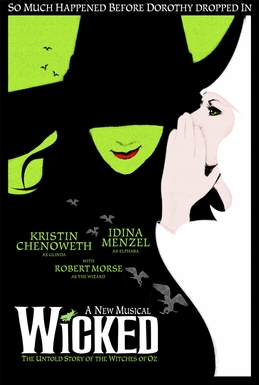
Perhaps that is what makes all incarnations of The Wizard of Oz intriguing and delightful whether it's Syfy's Tin Man, that musical in the West End, the 1939 film, or the original book.  This is what makes it such a rich source for reinterpretation and myth of its own.  It's so strong that it can even be deconstructed, rebuilt through a different lens and survive.  Take a look at Wicked (both the book and the musical, two very different creatures) for proof of that.  (I find it interesting that even though the focus character changes completely with Wicked, so much of the message stays remarkably the same....)

Tomorrow, I'll wear my new shirt happily.  Maybe it will give me some additional fortitude to face whatever challenges the day might bring me.  There's no way that could possibly be a bad thing.  I'll take any help I can get.

Friday, March 16, 2012

Shakespeare Land

Tuesday, I got to go to Stratford-upon-Avon, or as I grew to think of it, Shakespeare Land.  Although I had been before on a flying trip through, this time I got to see several things I had long wanted to see.  It was a strange, but good trip.

Our wonderful EF tour director, Hadleigh, prepped us for arrival with a detailed lecture about Shakespeare's life.  It sort of kills me how casual the English are with their famous people, even their monarchs.  I love it.  Everybody is like a member of the family, deserving of a nickname and the loving scorn you'd give a cousin or brother who gets into trouble but is still loved.  I guess this is a Southern thing, too, because I totally understand that.  Anyway, he called Shakespeare "Shakey."  Love it.

Our first stop in "Shakey" Land, then, was at Anne Hathaway's Cottage, a place I had not been able to go last time.  It was lovely.  The gardens were just coming into bloom, and had we been there even two weeks later, I think they would have been stunning.  It is always so bizarre to be walking through those rooms and across those floors and realize that someone you read and study, someone so important like Shakespeare, was there, too.  It seems so improbable even though everybody had to live somewhere.  It just doesn't sink in, somehow, that it could actually be here, this place where you're standing at that present moment.

We went from the Cottage to lunch, and then from there on to the Birthplace.  I had been to the Birthplace before, they've done extensive renovations there, adding multimedia at the beginning, and more than ever before, it really did feel like "Shakey" Land.  It was grand, though.  They also had about a million guides inside who were very chatty.  I didn't remember that from last time.  It was nice, but it took a lot of time.

That meant that the last stop in the "park," Holy Trinity Church, was going to be a scramble in the time I had left.  But I was BY GOD GOING TO HOLY TRINITY.  I missed it on the last trip because of a kid and his meds, and this time, I was going to see the grave.  I teach that inscription every year, and to have to stand up in front of another class full of students and have to say, "Yeah....I've been there twice now, and no, I haven't seen it yet," was not going to wash with me.   One of the other teachers on the trip and I booked it across town.

It was amazing and powerfully moving.  Even though I've seen photos of it for years, I don't know.  Standing there in that space before the altar was incredible.  There is a huge bank of stained glass and five graves, one of which is Shakespeare's.  To finally see the resting place and the famous epitaph of the man who wrote all those words that make up so large a part of my life was a very personal thing to me.  It is hard to explain.  It was in many ways something like a holy moment.

Of course, I had one thing left to do....  I needed my own picture of the Black Fool that stands in the middle of town.  How could I, your very own Dancing Fool, not take a picture of that?  I was running so late that I did not have time to line up shots properly and from all the right angles.  I barely had time to point the camera and release the shutter.  I did get a couple of shots, though.  I guess that counts for something.  I really wanted to work that statue, though.  I guess that will have to wait for the next trip.

Yeah.

Right.